

Contribution to the Dutch economy
In 2025, we measured our contribution to the Dutch economy for the third consecutive year, using an input-output economic model. With this model, we calculate direct, indirect, induced, and forward effects for all investment portfolios with the exception of public investments.
- By the end of 2025, the total committed amount was €932 million to export finance, investment loans, equity and project development, but excluding investments under the IIPP portfolio.
- Over the full investment tenure of our investments, this is expected to contribute €557 million to Dutch GDP.
- Additionally, our investment portfolio is projected to support 5,104 full-time equivalent (FTE) jobs in the Netherlands for the full investment tenure. Of this, €463 million comes from direct, indirect, and induced effects, and €94 million from forward effects.
- To assess the overall impact on the Dutch economy, we used the total committed investment amount as the basis for calculating the various economic effects through our input–output model.


Contribution to SDG 8 - Decent Jobs supported
We report our job-supported results based on direct and indirect jobs outside the Netherlands. To assess job decency, Invest International aims to ensure that workers receive at least a living wage and benefit from good working conditions.
Direct Jobs
These are the full-time equivalent (FTE) employees working for the company or project in which Invest International has invested.
- In 2025, job intensity amounted to 61 jobs per million euros invested accross our complete portfolio, divided into 41 and 93 jobs per million euros invested for respectively our capital and managed funds portfolio. This is slightly lower compared to 2024 due to variations in our total portfolio.
- In total, Invest International supported 23,181 direct jobs in 2025, of which 8,869 jobs were occupied by women (38%). Over the full investment period from 2021 to 2025, a total of 97,571 direct jobs were supported.


Indirect Jobs
Indirect jobs are supported by our customers through supply chains, wage-related spending, and wider economic activity enabled by our financing.
- In 2025, we supported 54,549 indirect jobs, primarily through projects financed via our managed funds, with a strong focus on start-ups, SMEs, and mid-sized companies.
- Over the full investment period from 2021 to 2025, a total of 209,521 indirect jobs were supported, reflecting the broader economic impact of our portfolio.


Commitment to living wage
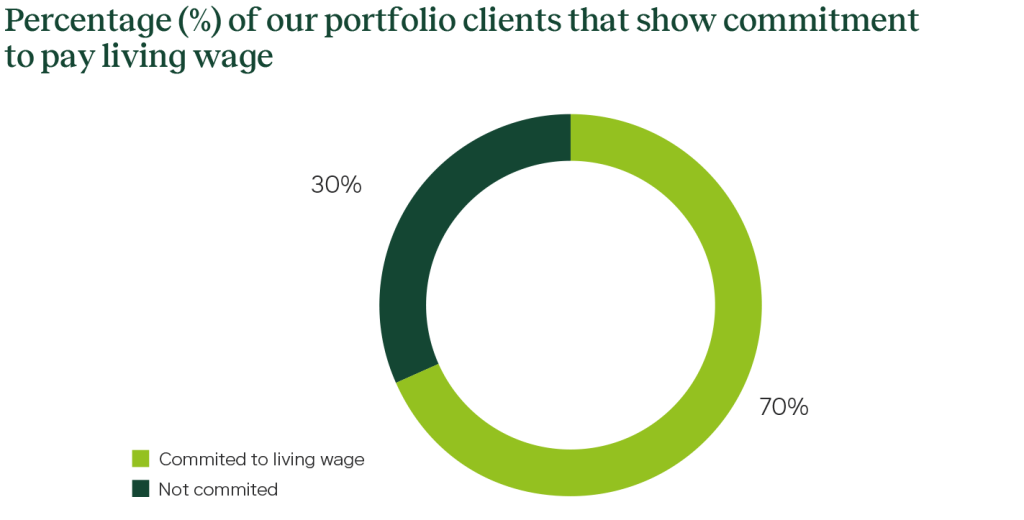
Invest International encourages its clients to pay living wages to all workers according to the location of the operation. A commitment requires showing evidence of a concrete living wage roadmap and execution plan based on the Wage Indicator Foundation benchmarks.
Investments that meet this requirement are included in our estimate of the indicator “Percentage (%) of our portfolio clients that show commitment to pay a living wage.” In total, 70% of our investments active in 2025 met this requirement.
Contribution to SDG 13 – Financed and avoided emissions
In 2025, Invest International began developing a comprehensive decarbonisation strategy and implementation plan. We systematically monitor our entire project and investment portfolio to identify opportunities for greenhouse gas emission reductions, measured through financed Emissions and Avoided Emissions (tCO2e).
Financed Emissions (tCO2e/Year)
We modelled most of our financed GHG emissions for 2025 using the Joint Impact Model (JIM) methodology and a limited number was directly reported by the client.
- This covers Scope 1, 2, and 3 (upstream) GHG emissions, totaling 395 thousand tons of CO2 equivalent (2024: 513 thousand tons).
- The decrease of financed emissions in 2025 is related to a lower exposure of our overall portfolio in euros. In 2025, the GHG emissions intensity was 1,037 tCO2e per million euros invested, divided into 492 and 1,912 tCO2e per million euros invested for respectively our capital and managed funds portfolio.


Avoided Emissions
For the 2025 report, we chose not to report avoided emissions at the portfolio level. Current data coverage and methodological heterogeneity limit comparability. Avoided emissions are deemed not material to our portfolio, and robust, conservative estimates are limited to a small share of assets. We prioritise financed emissions measurement using established standards.
Following the Partnership for Carbon Accounting Financials (PCAF) 2025 supplemental guidance specifically on financed avoided emissions, we are assessing the feasibility of becoming a PCAF signatory to align our investment‑emissions accounting and governance with the latest PCAF approach to avoided emissions.
Green Labelled portfolio
We assess whether our projects and investments contribute meaningfully to climate change mitigation and enhance resilience to the impacts of climate change by using the Green label methodology developed by Atradius Dutch State Business (ADSB). We aim for green labelled to comprise 30% of portfolio disbursements by 2025.
- In 2025, 24% of the total disbursed amounts in our portfolio were directed towards green-labelled projects. Among these, sustainable manufacturing related projects received the highest amount of Green Labelled disbursements being 35 million euros.
- The total of disbursements for green labelled projects was 134 million euros for our portfolio during 2025. The total number of green labeled projects was highest for Agri-food and Infra and Water strategic themes, respectively 47 and 46 projects.


Overall contribution to SDG 8 and 13
We are committed to ensuring that by 2025, about 66% of our capital investments and managed funds contribute to SDG 8 and 13. Our assessment of the overall contribution of our financed portfolio to SDG 8 (decent work and economic growth) and SDG 13 (climate action) is based on our internal performance benchmarks.
In 2025, 68% of our portfolio supported SDG 8 (2024: 67%), while 82% supported SDG 13 (2024: 75%).


Contribution to other SDGs
Sector strategies have been formulated for the five key sectors of Invest International, incorporating guiding impact indicators and transition themes. The sector-specific impact results for 2025 are outlined below:


Impact Management
At Invest International, our strategic objective is to finance and develop impactful projects worldwide that strengthen the Dutch business community and economy, while contributing to the achievement of the Sustainable Development Goals (SDGs).
Our Impact Framework details the approach to achieving impact and how it is implemented.

IESG Management Tool (RISE)
Our IESG management tool, RISE (Reporting Impact Sustainability and ESG) assists Invest International in streamlining and enhancing Impact and ESG management processes. In 2025, we focused on the integration of impact and ESG-related results allowing for an integrated and automated presentation of portfolio results and connecting these with the Integrated Enterprise Reporting (IER) framework within Invest International. We improved the overall performance and user friendliness of RISE and introduced an online form for the collection of impact and ESG data for our clients.

How Impact and ESG are managed
The ultimate responsibility for impact and ESG matters lies with the Management Board, under supervision of the Supervisory Board.
Sustainability, impact and ESG considerations are embedded into their decision-making and long-term strategy.
Impact and ESG are fixed and recurring topics in the approval process for all our investments and grants. Invest International maintains a three-lines governance and risk management model as part of its overall risk management system. IESG is integrated in Invest International’s investment cycle and, as a general principle, each of the three lines includes ESG expertise. In 2025, IESG capacity amounted to 19 FTEs.


