
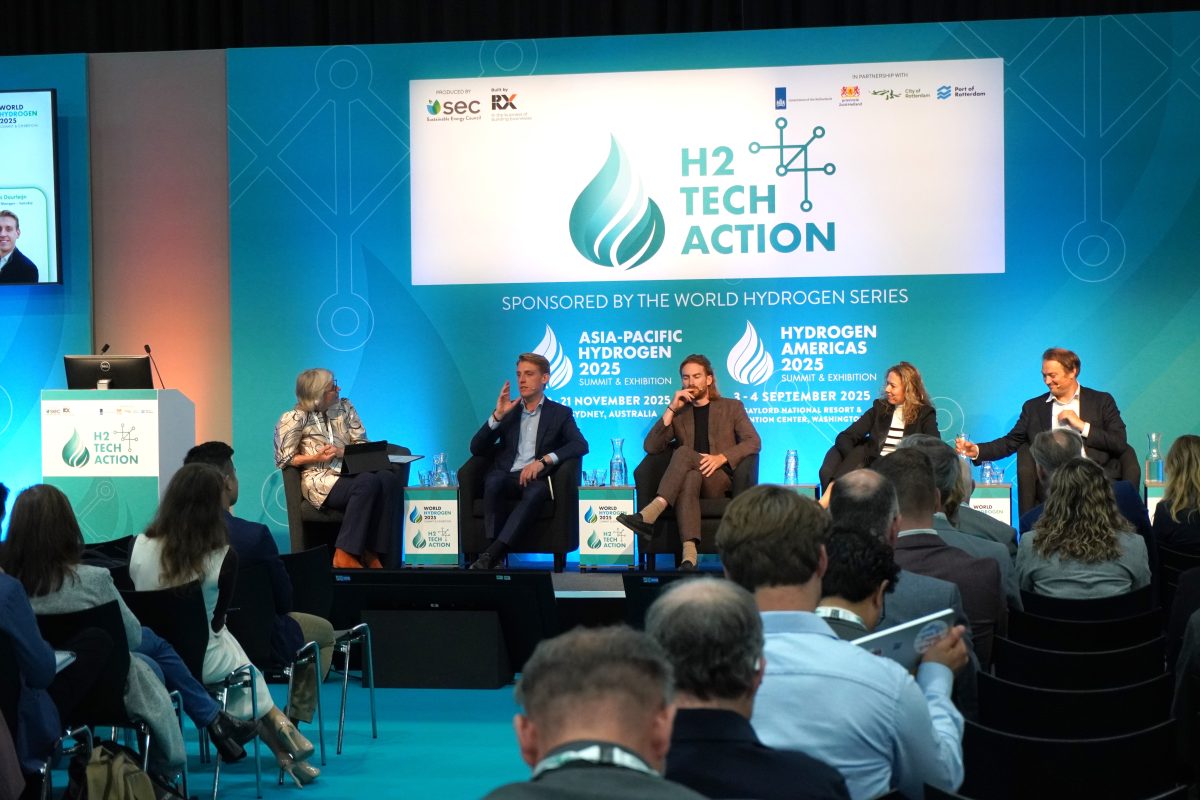
At this year’s World Hydrogen Summit, the Finance Forum—organized by the Dutch government, in partnership with the World Bank, FMO and Invest International—brought together global experts, from project developers to financiers, to explore how to scale proven financing models, stimulate market demand, and build the partnerships needed to accelerate the green hydrogen value chain.
Finance Forum in Brief
The forum began with a call to action by Rogier van Tooren, Head of International Financing and Emerging Markets at the Dutch Ministry of Foreign Affairs: the time has come to move from promise to implementation. In his view, green hydrogen is not only a climate solution, but a geopolitical opportunity—especially in emerging markets, where it can support both energy independence and job creation.
Dolf Gielen, Hydrogen Lead and Senior Economist at The World Bank, in his keynote highlighted the growing use of clean hydrogen worldwide—now reaching 4 million tons of green and 5 million ton of low carbon hydrogen annually—and the ambition of the 10GW Lighthouse Initiative to accelerate electrolyser deployment by 2030. While progress is evident, Gielen noted that the sector is still advancing more slowly than hoped, with issues around policy frameworks and offtake still holding back momentum.
The first panel brought together experts from IFC, IDB, HSBC, Santander, FMO, and Atome, who shared insights on financing large-scale green hydrogen supply. Panelists emphasized that viability alone isn’t enough; projects must also be bankable, with predictable cash flows and strong risk allocation. Regulation can be a barrier in some markets, they noted, but emerging economies may offer faster paths forward.
The remainder of this article zooms in on two key moments from the forum: the keynote themes introduced by Jorgo Chatzimarkakis, and the second panel discussion moderated by Itske Lulof, Head of Energy & Climate at Invest International, which tackled a critical but often overlooked question: how do we unlock bankable demand?
Keynote: Europe’s regulatory straitjacket
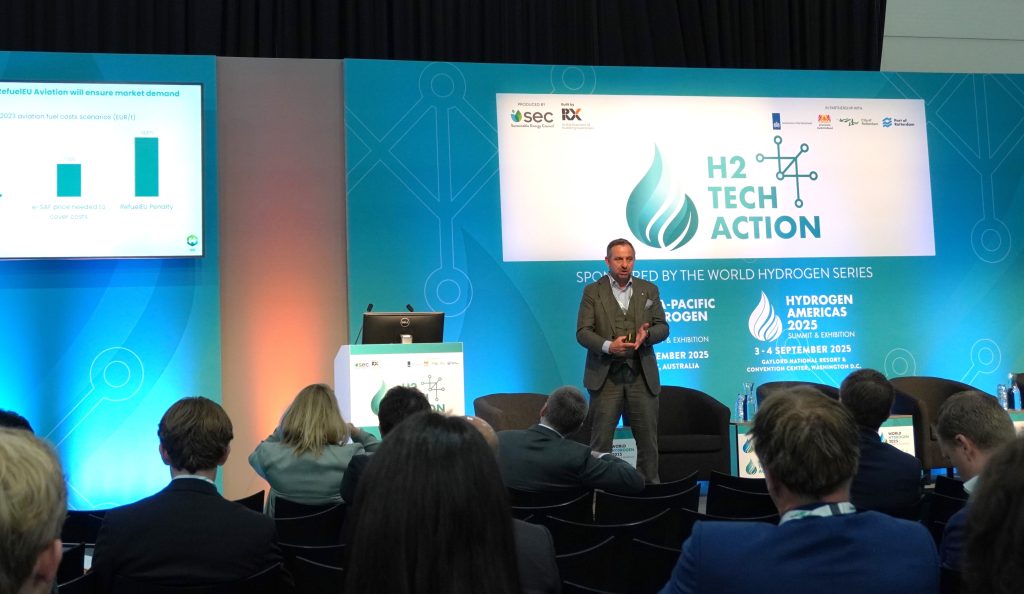
In his keynote, Dr. Jorgo Chatzimarkakis, CEO of Hydrogen Europe, offered sharp reflections on Europe’s role in the hydrogen market.
“In Europe, we want to lead into perfection—regulatory perfection,” he said, warning that this risks putting a straitjacket on a nascent industry now only in its fifth year.
He also pointed to what he called a form of “toxic positivity”— Europe’s rigid focus on electrification without addressing the reality of limited grid capacity. Instead, he argued, we need sectoral integration: building the grid alongside the electrification of industries, rather than in isolation.
Lead markets as a pragmatic path
Chatzimarkakis pointed to the EU’s efforts to establish lead markets in sectors like clean refining, clean steel, maritime, e-SAF, and data centers. These, he said, are more business-focused and are even supported by mandates—offering a more workable path to build early demand.
Defense spending as a green hydrogen opportunity
He also highlighted a surprising opportunity: ReArm EU, the European defense initiative. As billions are invested in national security, Chatzimarkakis suggested this could also pull forward green hydrogen innovation. “Why not green hydrogen in submarines? Green ammonia in artillery?”
He emphasized the need to convince politicians of this dual-purpose approach.
“Apparently it’s okay to indebt our society for defense—but let’s make sure we combine it with innovation and sustainability.”
Panel: Unlocking Demand – From Risk to Reality
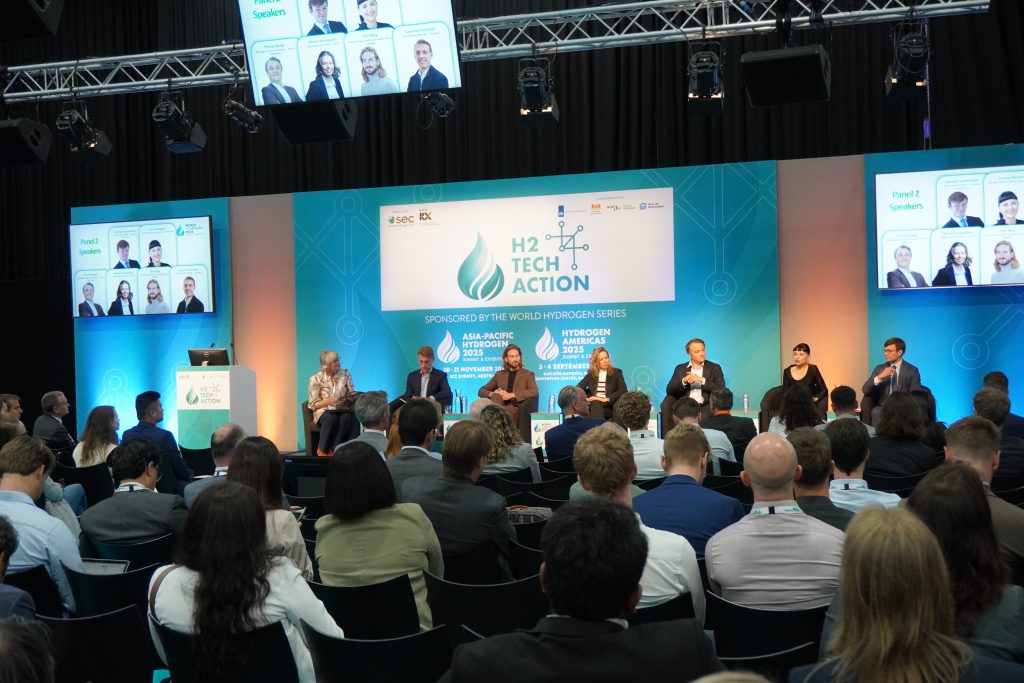
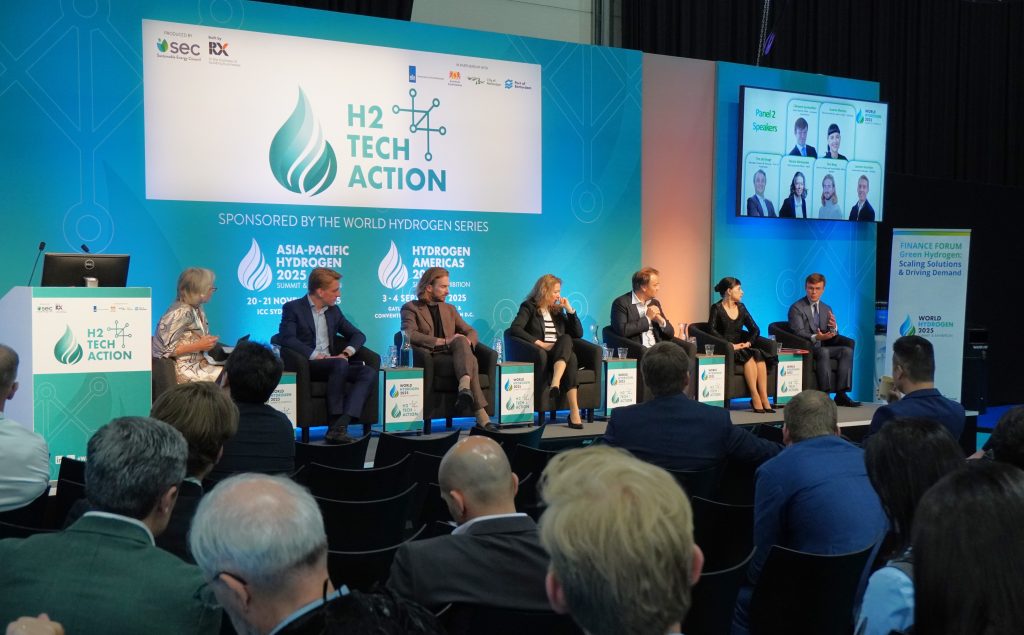
The second panel of the Finance Forum, moderated by our own Itske Lulof, Head of Energy & Climate at Invest International, shifted the focus from supply to a central challenge: how to unlock and sustain market demand for green hydrogen. With panelists from SkyNRG, Samskip, Hy24, the Port of Rotterdam, the European Commission, and H2Global, the session explored what it will take to turn ambition into action—and ideas into investable projects.
1. Market maturity is coming—but confidence still lags
Compared to just a year ago, the panel noted real progress: projects are now coming to life, and demand is building across sectors. But as Itske Lulof highlighted, hesitation remains. Many offtakers are still cautious especially for signing binding long-term contracts, financiers are looking for precedents, and developers are navigating an uncertain landscape.
“Financiers need to get comfortable with how the various risks in these projects can be mitigated through collaboration and risk sharing amongst all parties in the project and the value chain,” she said. “And we need to educate all parties on how to make this work.”
2. Innovation and scale are needed to break the gridlock
One of the clearest signs of market appetite came from SkyNRG, a pioneer in sustainable aviation fuel (SAF), which launched a debt capital raise that was significantly oversubscribed—demonstrating that capital isn’t the issue; bankability is. That bankability was made possible by extensive de-risking work, including securing long-term offtake agreements, leveraging regulatory frameworks, and spreading risks along the value chain by ensuring each party carried the risks they were best positioned to manage.
At Hy24, the world’s first and largest hydrogen private equity asset manager, the strategy is clear: invest early, derisk gradually, and share learnings across the portfolio. But they stressed the need for banks to accept projects that aren’t fully proven.
“We still need a lot of innovation and scaling up to bring the costs of green hydrogen projects down, so banks need to accept that projects may not be fully proven,” said Nicole Vermeulen of Hy24.
3. Regulation is a driver—not just a barrier
For companies like Samskip, a European logistics provider offering multimodal transport by land and sea, regulation has played a critical role in enabling their green transition. EU regulations have helped justify investments in alternative fuel vessels, including those being developed for green hydrogen.
Meanwhile, the Port of Rotterdam plays a critical enabling role—bringing industries together to identify bottlenecks, whether financial, regulatory, or contractual. They help build momentum, even when they can’t remove every barrier themselves.
4. New tools are emerging to make hydrogen demand visible
One of the biggest hurdles? Long-term contracts. For example, in a sectors like shipping, maritime fuel is traded as a commodity based on short term offtake. Customers often are not willing, or can’t commit beyond a few years at max. This makes it difficult for producers and financiers to underwrite large-scale investments.
To help overcome this, new tools are emerging to bring clarity and coordination to the market. One example is the H2Global mechanism—a pioneering double-auction model that acts as a market maker for clean hydrogen. Through its intermediary, Hintco, H2Global bridges the gap between producers and buyers who struggle to connect in the early stages of market development. Hintco buys hydrogen-based products for a guaranteed 10-year period in an auction and resells them on a short-term basis also via auction, with the price difference covered by public funding. By simulating a functioning market, H2Global helps stimulate demand, offering transparency and accelerates market formation.
Complementing this is the H2 Mechanism, a new platform being launched by the European Commission. Designed to boost transparency and coordination, it will connect existing and future hydrogen demand and supply, link stakeholders with financing, and gather interest in infrastructure and storage projects. Complementary to H2Global, it includes a strong focus on the infrastructure side of the value chain—adding another layer of visibility to support smarter investment decisions.
As Clément Gerthoffert from the European Commission noted, the H2 Mechanism will help enable long-term connections between offtakers and suppliers of green hydrogen—contributing to a more connected and investable hydrogen ecosystem.
5. End-product pricing absorbing the cost of going green
Another theme that emerged from the panel was the idea that demand can be stimulated when the cost of green hydrogen is passed through to the final product—a strategy that, in many cases, has a surprisingly limited impact on end prices.
Panelists noted that the use of green steel in a car, for example, may only increase the total vehicle cost by a small fraction. Likewise, shipping a pair of shoes on a vessel powered by green ammonia or methanol would increase the final retail price only minimally.
For this to work, though, it is needed to also have quotas enforcing the use of green hydrogen in end-products to help drive demand. The takeaway: we should be focusing more on where the price impact is minimal, and where smart policy and procurement can help tip the scales in favor of greener alternatives.
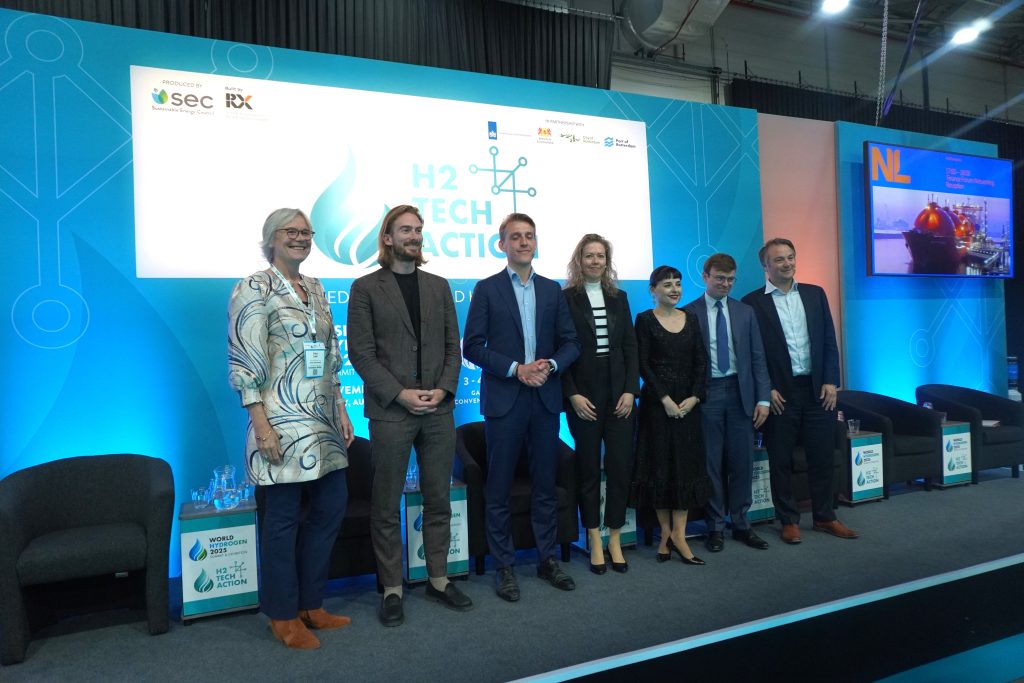
The session ended with a clear message from Itske Lulof: the fundamentals are falling into place, but confidence and coordination are still critical. Demand won’t unlock itself—it will take bold moves, smart tools, and committed partnerships prepared to work hard to derisk projects, to make hydrogen a reliable, investable part of the clean energy future.

